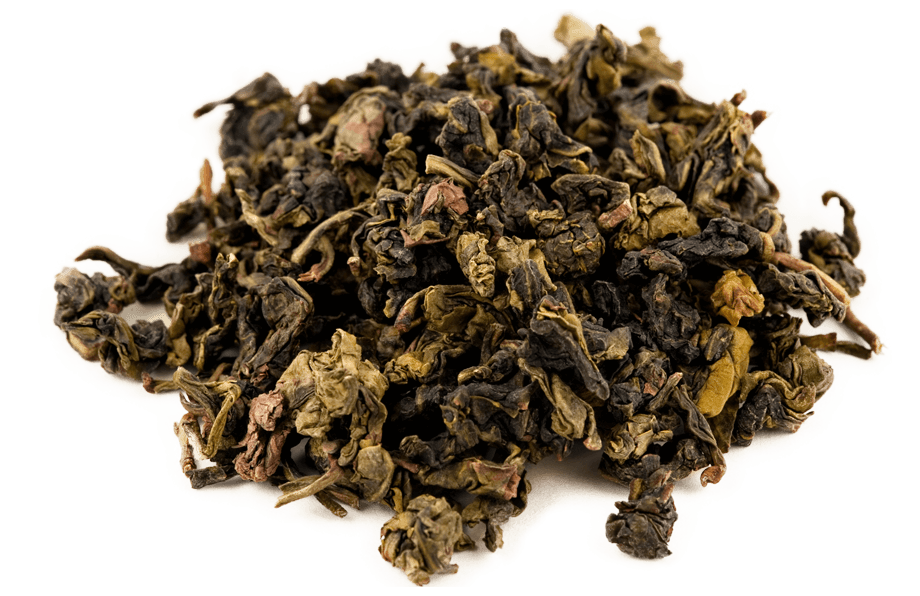
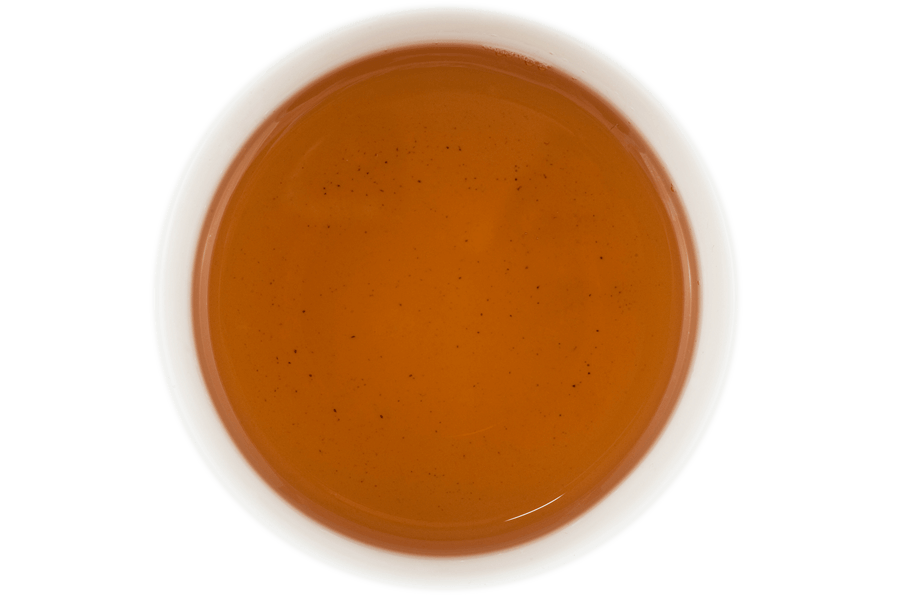
Ti Kuan Yin is the most famous of all organic oolong tea. This Fair Trade Certified organic Chinese tea is grown in the southern reaches of China's Fujian Province. The tightly-rolled dark green organic loose leaf tea leaves yield a pale golden, smooth-bodied infusion with a complex aroma having accents of sweet flowers, rich greens and forest floor. The taste of the thick, nectar-like liquor is lightly vegetal, with slight floral qualities and a rich butteriness. The characteristic "oolong glow" is quite prominent. As with our other Chinese oolongs, our Ti Kuan Yin may be infused multiple times, with each infusion revealing a new nuance of this tea's complex flavor.
Please note: for our frequent Ti Kuan Yin Oolong customers, our latest manufacture of Ti Kuan Yin has a much more vivid green color in the dry leaf and a less pronounced floral quality when compared to previous batchs this year. Don't be alarmed! An excellent oolong, this latest batch exhibits the perfect Ti Kuan Yin green leaf and a beautifully round, buttery oolong flavor profile.
|
Ingredients: organic Chinese oolong tea |
|
Serving Size: one level teaspoon per 8 oz cup of water |
|
Aubrey Says: Be sure to steep this tea more than once - one infusion will only scratch the surface. |
|
Jeremy Says: A tea to be contemplated - very complex! |
Posted by Lukasz M. on 7th Mar 2012
After going through a bulk size of the Makaibari Estate oolong tea, I wanted to treat myself and buy the bulk size of the more expensive Ti Kuan Yin. Much to my surprise, the higher price did not equate to a better tea. In fact, I was very disappointed in this tea. I have finally finished up my bulk size container of it and I'm glad to be moving on to another tea. With respect to aroma, this oolong has a strange shellac, shoe-polish scent prior to steeping. It comes off unnatural in my opinion. Luckily, the strange aroma does not carry over to the flavor. Instead, the flavor is very dull, stale, and cardboard like. Since I always do multiple infusions of tea, I often found myself overcompensating for the lack of flavor by adding 2-3 times the amount of tea I would normally add. I can't say much else about it. It's just boring and a disappointment. I would not recommend it.
Posted by Anne on 3rd Oct 2011
The description is very fitting, floral yet forest floor is what this tastes like. Very complex and soothing, it tastes like it has the power to heal. It's not vegetal like greens nor is it bitter. The first infusion seems to be the best, but all are delicious.

We at Arbor Teas firmly believe that tea should be brewed to suit your personal taste. With that being said, here are some recommendations to get you started, but please remember you can make adjustments based on your own personal taste.
There are three main considerations when brewing tea: quantity of tea, water temperature and steeping time.
|
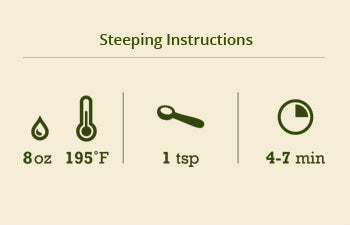
Quantity of tea: one level teaspoon per 8 oz cup of water |
|
Water temperature: use water that has been heated until the first bubbles begin to rise from the bottom of the pot (195° F) |
|
Steeping time: 4-7 minutes |
Tip #1: Use fresh water whenever possible - water that has been sitting in your kettle overnight may impart a flat or stale taste to your tea. Be careful not to boil your water for too long. Over boiled water can sometimes impart an unwanted taste.
Tip #2: Keep in mind that brewing your tea for too long can extract undesirable bitterness from the leaves, so steeping time matters! For a stronger brew, don’t steep longer, just use more tea.
Learn more from our step-by-step guides on how to brew loose leaf tea, how to make iced tea, and how to make tea lattes. And don’t forget to check out our Eco-Brewing Tips, too!

There are five significant components found in all tea from the plant camellia sinensis: essential oils, which are the source of tea’s delicious flavor and aroma; polyphenols, which are antioxidants that provide the tea’s brisk flavor and many of its health benefits; phytonutrients, which are small amounts of vitamins, minerals, and amino acids including L-theanine (a very rare molecule that has been found in only three sources including camellia sinensis!) ; enzymes; and methylxanthines, which are a family of alkaloids that include caffeine. Each of these components work differently in the human body and a full description is best left to a medical journal. However, recent research exploring the potential health attributes of tea is leading many scientists to agree that tea, may contribute positively to a healthy lifestyle.
For a more in-depth discussion of Tea and Health Benefits check here.
For a more in-depth discussion of Tea and Caffeine check here.
According to legend, the name Ti Kuan Yin came from a Qing Dynasty Emperor who became very ill, and no remedy could cure him. One day an advisor to the court (from Fujian) shared some of his homegrown oolong tea with the Emperor, who was miraculously cured. Upon his recovery, the Emperor named this tea "Ti Kuan Yin," which translates to "Iron Goddess Of Mercy". The Emperor declared that the tightly rolled and well-baked tea leaves resembled iron and had the healing powers of the Buddhist Goddess Of Mercy (Kuan Yin).
In China, tea is often brewed using the meditative Gong Fu method. This very formal, ritualized approach to tea preparation dates back to the Ming dynasty (1368-1644 AD). The term "Gong Fu" refers to skill gained through practice - expertise derived not from learning but experience. While the term "Gong Fu" could signify the serious practice of any art form, such as the martial art of related name (Kung Fu), Gong Fu Cha refers to the elaborate preparation of tea using miniature Yixing pots and cups. Yixing teaware is named for the purple clay it is made from, which hails from Yixing in China's Jiangsu province. Everything in Gong Fu service is small and delicate, placing emphasis on the elegance of the tea. Oolongs are the preferred tea in the Gong Fu ritual; they are steeped multiple times to highlight the evolution of taste as the leaves unfurl.
For information on other traditions or to submit your own tea tradition visit our Tea Traditions section.
Loading... Please wait...